EVERY REP
NEEDS A REASON.
We look closely at the player, the task and the context. Then we make training decisions we can explain.
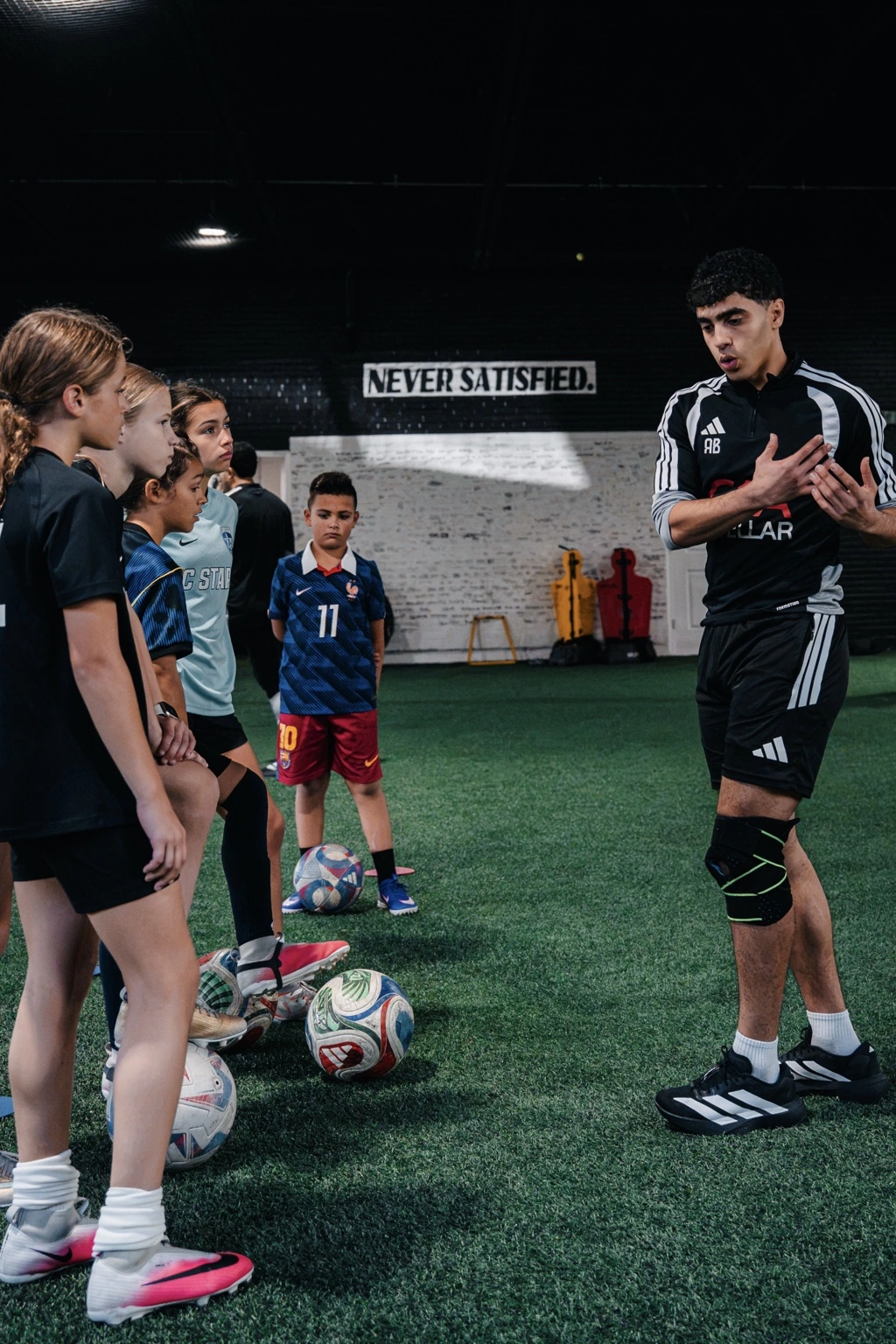
FIRST,
UNDERSTAND.
We do not begin by choosing a drill. We begin with the player and a real soccer action. Where does it break down? Is the limitation in coordination, technical execution, perception, force production, timing or the pressure of the situation? Sometimes the cause is not where it first appears.
That assessment does not give us a universal formula. It gives us a working hypothesis. We select practice that addresses the likely limitation, observe what changes, and revise it when the game tells us the answer was incomplete.
DETAIL IN SERVICE
OF THE GAME.
Simple practice has a serious job. A player might need time to refine one contact, movement or decision before we add more noise. That is not a failure of imagination. It is a choice to give a specific quality enough attention to improve.
Then the task must evolve. We alter cues, angles, speed, opponents or consequences until the improved action can be expressed under recognizable soccer pressure. No amount of clean repetition in isolation proves transfer by itself.
REPETITION IS A DOSE.
Repetition has a purpose, a dose and a context. The value lies in what the player learns to do, not how many times we can count an action.
A clear pass, an open body shape and one forward target. Coach the detail before adding pressure.
The pass arrives from different angles. The receiving player must adjust the touch to find the same forward target.
A defender can close the lane. The player must receive, recognize the opening and decide whether to pass, carry or protect.
Illustration: P is the passer, R the receiver. One soccer action under changing demands, not a fixed three-step formula for every player.
THE WORK DOESN’T HAVE TO LOOK NEW TO BE NEW TO THE PLAYER.
Coaches often feel pressure to produce a different drill every time, to entertain an audience or justify a session on camera. We understand the pressure; we have worked in that environment. But the body does not adapt according to a content calendar. Young players deserve enjoyment and exploration. Committed players also need patience with repetitions that are quiet, specific and sometimes unglamorous.
What we ask for is not blind discipline. It is curiosity about the reason for the work, and the willingness to stay with an important detail until the player is ready for a harder version of the problem.
THE MATCH
CHANGES THE SESSION.
A player preparing for a match in two days needs a different training emphasis from that same player in a period with more time to build speed, strength or repeated-action capacity. The difference is not simply working hard versus working easy. It is choosing the right stimulus without losing the next performance.
We consider recent workload, high-speed running, acceleration and braking, strength exposure, recovery and the demands of the player’s position. Training load means both how demanding the work is and how much of it the player performs.
THE SAME PLAYER. TWO DIFFERENT PRIORITIES.
The same player, the same goal of improving, but a different decision because the next match is closer or farther away.
The player may still perform fast, decisive actions, but we carefully limit total repetitions, unnecessary heavy loading and demanding changes of direction. Quality matters; so does arriving ready to play.
With appropriate recovery, we may gradually increase sprint exposures, braking demands, strength work and repeated efforts. The aim is long-term adaptation, not just feeling tired after a session.
What changes? The intention, total work, physical exposure and recovery plan. These are examples, not a fixed schedule; age, match minutes, readiness and team training always matter.
BRING YOUR
QUESTIONS.
Our first conversation establishes the player, the goal and the training context.
START TRAINING